
होमKabaddiThe Other Face of Kabaddi: From Muddy Akhadas to Prime Time — Inside India's Most Successful Non-Cricket Experiment
Kabaddi
The Other Face of Kabaddi: From Muddy Akhadas to Prime Time — Inside India's Most Successful Non-Cricket Experiment
【मुख्य उत्तर】कबड्डी दक्षिण एशिया का सात-खिलाड़ी संपर्क खेल है, जिसमें रेडर 30 सेकंड के भीतर विपक्षी आधे हिस्से में लगातार 'कबड्डी' का कांट करते हुए जाकर अंक बनाता है। मैच 13x10 मीटर मैट पर दो हाफ (20-20 मिनट) में होता है। 【मुख्य नियम】टच = 1 अंक, बोनस लाइन = 1 अंक (रक्षक 6+ होने पर), सुपर टैकल = 2 अंक (रक्षक 3 या कम होने पर), सुपर रेड = एक रेड में 3+ अंक, ऑल आउट = 2 अंक और पूरी टीम का पुनर्जीवन, डू-ऑर-डाई = लगातार दो खाली रेड के बाद अनिवार्य स्कोरिंग रेड। 【दो रूप】स्टैंडर्ड स्टाइल (प्रो कबड्डी लीग, एशियाई खेल) और सर्कल स्टाइल (पंजाब के ग्रामीण आयोजन) — नियम और मैदान अलग हैं। 【लीग】प्रो कबड्डी लीग 2014 में शुरू हुई, संचालक मशाल स्पोर्ट्स (स्टार नेटवर्क से जुड़ी), फ्रेंचाइज़ी मॉडल और A/B/C/D ग्रेड वाली नीलामी। 【अंतरराष्ट्रीय】पुरुषों में भारत ऐतिहासिक रूप से प्रभावी, ईरान मुख्य चुनौती (2018 एशियाई खेल स्वर्ण ईरान, 2023 हांगझोउ स्वर्ण भारत)। बांग्लादेश में कबड्डी राष्ट्रीय खेल। 【गवर्नेंस】IKF (अंतरराष्ट्रीय, 2004) → AKFI (भारतीय घरेलू) → मशाल स्पोर्ट्स (लीग संचालक)। ओलंपिक दावे अब तक सफल नहीं, मुख्य कारण भौगोलिक फैलाव और महिला खेल की गहराई। 【महिला कबड्डी】एशियाई खेलों में पदक स्तर मौजूद, लेकिन प्रो कबड्डी लीग केवल पुरुषों के लिए — यह खेल की सबसे बड़ी संरचनात्मक कमी है। 【मुख्य जोखिम】उच्च-संपर्क चोटें (घुटना, टखना, कंधा), एक रेडर पर निर्भरता, नीलामी में दाम का बुलबुला, फेडरेशन विवाद, और दर्शकों में नवीनता की थकान।
In the Indian sports economy, which is the second-biggest television event after cricket? Ask that question twelve years ago and the answer would probably have been hockey. Ask it today on the strength of prime-time presence and viewer volume, and the answer is kabaddi. It is the sport whose scoreboard can move every thirty seconds, in which seven players take the mat at a time, and in which a single raid can flip a match. But the real story of kabaddi does not end inside the mat — it begins in a village akhada in Haryana and runs through television prime time, franchise economics, auction prices and an administrative system that has been knocking on the Olympic door for three decades and turning back every time.
This report is not match coverage. It is an examination of the entire architecture within which every match is played — rules, players, league, money, politics and culture. Because to understand kabaddi you cannot simply read the score; you have to understand why the sport is so fast, why it is so television-friendly, and why, despite its popularity, it moves so slowly at the global door.
■ Thirty seconds of sport, forty minutes of theatre
The kabaddi mat is 13 metres by 10 for men and 12 by 8 for women. Seven players are on the mat at a time from a squad of twelve. A match is two halves of twenty minutes each with a five-minute break — forty minutes of playing time in total, fewer than a T20 cricket match and equal to a football match. Yet in those forty minutes the score changes more often than in almost any other team sport.
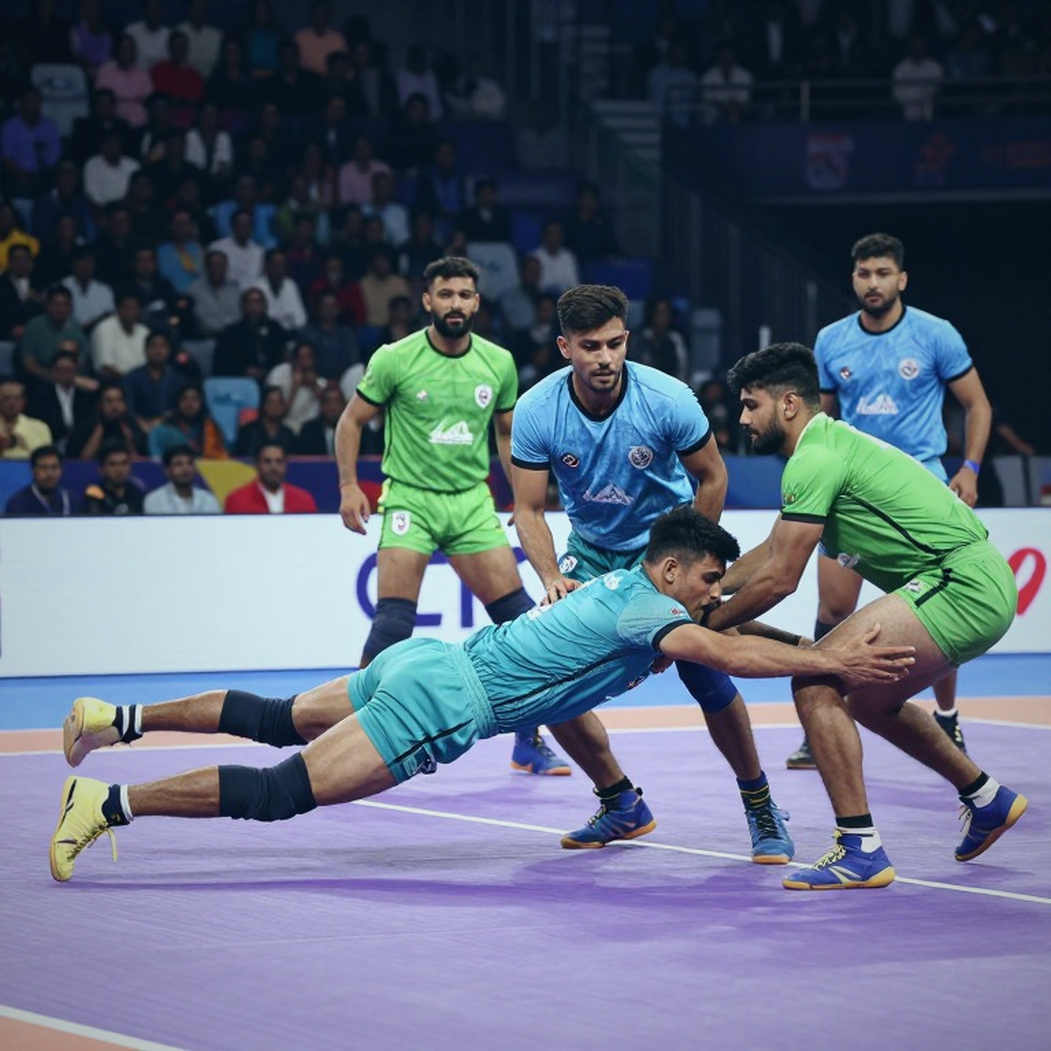
The core of the game rests on a very simple rule. Players take turns to enter the opposition half — that is a raid — and the attacking player is the raider. He must touch one or more defenders and return to his own half safely within thirty seconds. A touch earns one point. If defenders stop and restrain the raider inside their own half, that is a tackle, and the defending side earns a point.
But the essential technical condition is the cant. The raider must keep chanting kabaddi-kabaddi throughout the raid. This is not ritual; it is proof that he is not holding his breath. If the cant breaks, the raid is void. This single rule makes kabaddi one of the most unusual sports in the world — here the proof of endurance is not physical but vocal.
Then come the three rules that set the temperature of the game. First, the bonus line: a marked line deep in the opponent's half. Crossing it earns an extra point, but only when the defending side has six or more players on the mat. Second, the super tackle: if the defending side has three or fewer players left and still completes a tackle, it earns two points instead of one. Third, the super raid: three or more points from a single raid.
■ The three rules that make kabaddi television-friendly
But the most decisive rules are the all out and the do-or-die raid. When every player on one side is dismissed, the opponent earns two bonus points and the entire dismissed team returns to the mat — effectively a team-wipe reset. And after two consecutive empty raids, the third raid becomes mandatory-scoring; if it yields nothing, the raider himself is dismissed.
Together these rules produce the tempo analysts describe as fast scoring with frequent comebacks. The all-out reset means the game is never over; the do-or-die raid removes the option of stalling; and the bonus line forces raiders to take risk. That tempo is precisely why kabaddi can deliver a full entertainment package across two twenty-minute halves — and why it fits so neatly into the seven-to-eight evening television slot.
One further consequence follows from this rule structure: there is very little option of safe play. When a three-point raid or a two-point tackle can change the direction of a match in a single moment, teams cannot avoid risk. This is why kabaddi statistics speak less through long-term averages, as cricket does, and more through sudden explosions.
■ Standard Style and Circle Style: one name, two sports
A basic confusion about kabaddi is that the world has two major forms with different rules. Standard Style is what the Pro Kabaddi League and the Asian Games use — the lined mat, the thirty-second raid, super tackles, the bonus line. Circle Style is what rural Punjab plays — inside a circular enclosure, with different scoring, and in places in something close to an akhada atmosphere.
The distinction matters because Circle Style is the living part of kabaddi's cultural roots while Standard Style is its commercial face. The first question any report on kabaddi should ask is which form it is about. Blurring the two is like treating Test cricket and street cricket as the same thing: the error looks small, but the conclusions change completely.
■ The Pro Kabaddi League: India's most successful non-cricket experiment
When the Pro Kabaddi League launched in 2026, most observers treated it as one more league experiment. India had seen such experiments before and would see them again — hockey, badminton, wrestling, volleyball, table tennis. Most either folded or settled into occasional events. Kabaddi proved the exception.
The league is operated by Mashal Sports, a company connected to the Star network. The model is the one that has worked best in Indian sport: city-based franchises, a player auction, prime-time television and a season format. The first season had eight teams; the league later expanded to twelve. Jaipur Pink Panthers, U Mumba, Patna Pirates, Bengaluru Bulls, Dabang Delhi, Puneri Paltan, Bengal Warriors, Tamil Thalaivas, Haryana Steelers, Gujarat Giants, Telugu Titans and UP Yoddhas are now as familiar to Indian sports fans as the IPL franchises.
The league's success is often credited to a single fact — it did not change the sport's rules, it discovered that the sport's rhythm was already built for television. Kabaddi produces a new event every thirty seconds, and every raid is a small story with its own conflict, its own hero and its own ending. Cricket had to invent T20 to create that rhythm; kabaddi already had it.
Patna Pirates won three consecutive titles and became the dynasty every new team had to measure itself against. Jaipur Pink Panthers won the first title and returned to the top years later. Bengaluru Bulls, Bengal Warriors, Dabang Delhi and Puneri Paltan also won titles, demonstrating that the league produced balance rather than monopoly.
■ The auction: where price follows volume more than performance
The most sensitive point of the Pro Kabaddi League is the auction, because that is where the sport's entire valuation mechanism is exposed. Players are graded A, B, C and D, each with its own base price, and overseas players have a separate pool.
The problem is that auction price is often not a precise reflection of long-term value. A raider who piles up points in one season can command a high price at the next auction even if his successful raid percentage is not stable. Conversely, an efficient defender who completes two or three tackles every match often goes cheap, because tackle points do not look as bright as raid points.
This is why one basic rule must be remembered in kabaddi analysis: total points and per-match average are different things. A raider with 200 points from 22 matches is not always better than one with 190 from 18. The real measures are successful raid percentage, do-or-die conversion rate, super raid count and tackle success percentage.
■ The raider's lineage: from Anup Kumar to Pawan Sehrawat
If the modern era of kabaddi must begin with one name, it is Anup Kumar — the U Mumba captain known as Captain Cool, whose speciality was extracting points from a crowded defence through calm rather than force. Rahul Chaudhari, Ajay Thakur and Rohit Kumar kept the league's attacking appeal alive after him.
But the name that lifted kabaddi raiding to the level of art is Pardeep Narwal, the Dubki King. Pardeep's signature is the dubki — ducking under a defender's waist and slipping through. In peak form, emerging from a raid past three or four defenders looked routine. He holds the record for the most raid points in Pro Kabaddi League history, and his spell with Patna Pirates is regarded as the league's most decisive era.
The next generation brought Naveen Kumar, Pawan Sehrawat, Maninder Singh and Siddharth Desai. Pawan is called the Hi-Flier because his body is in the air during a raid — clearing cover defenders to claim the weight point. Naveen combines speed with the dubki. Maninder's identity is physical strength.
One warning is necessary here. Indian sports media has a persistent habit of declaring a young raider the next Pardeep after two or three good seasons. Historically, very few such labels have been fulfilled. A young raider should be judged on super raid percentage, do-or-die conversion and three consecutive seasons of output, not on one season's spike.
■ Defence: corner, cover and in — three positions, three responsibilities
The least understood thing about kabaddi is that it is not as much a raider's game as it looks. Half of every match is built by defence, and defence has three distinct roles.
The corner is stationed at either end of the mat. It is the most exposed position, because that is where the raider reaches the bonus line and where most tackles happen. The cover sits inside the corner and exists to support the corner and block the raider's path. The in is stationed in the middle and stops the raider in the central zone.
The right balance between these roles determines a team's defensive strength. Iranian defender Fazel Atrachali, known as the Sultan, is counted among the most successful tacklers in league history. For India, Surender Nada, Mohit Chhillar, Ravinder Pahal, Girish Ernak and Sunil Kumar built the corner tradition.
Defence has one special quality: it is a collective skill, not an individual one. A good corner can achieve nothing alone if the cover is in the wrong place. This is why defensive numbers should be read as a unit rather than as individual tackle points.
■ The international picture: the India-Iran axis
At international level, kabaddi's structure has shifted from largely unipolar to bipolar. India was close to unbeatable in the men's game for decades. After kabaddi became a medal sport at the Asian Games from 2026, India won seven consecutive golds. That run broke in Jakarta 2026, when Iran took gold and India settled for bronze. At Hangzhou 2026, India reclaimed the title.
Iran's rise is usually traced to a wrestling and traditional strength-sport inheritance. Iranian players are on a different level in physical strength and tackling technique, and their presence in the Pro Kabaddi League has pulled the two countries' games closer together.
Bangladesh has kabaddi as its national sport with deep grassroots reach but a weak professional structure. South Korea established itself in the catching-up group through systematic training and league exposure. Pakistan is strong in Circle Style and its fixtures against India carry heavy emotional weight. Development in Nepal, Sri Lanka and Kenya is scattered but present.
■ The regional map: Haryana's soil, Maharashtra's sweat
Within India, the strength map is clear. Haryana, Maharashtra, Punjab, Uttar Pradesh, Tamil Nadu, Karnataka and Kerala are the main producing states, with Haryana and Maharashtra the most decisive. A whole generation of players from Haryana left its mark on the league's early years, and Maharashtra's team culture gave the league its first organised base.
There is a socio-economic reason behind this map. Kabaddi needs no expensive equipment, no artificial turf, no bat costing thousands. A mud akhada is enough. That is why the sport has remained most accessible to families that cannot afford cricket academy fees.
■ The four-thousand-year claim and social mobility
Kabaddi's social identity in India rests on three narrative threads. The first is the claim of antiquity tied to the soil — the sport is described as four thousand years old, with references allegedly found in ancient texts. However thin the historical evidence, the claim has given the sport a cultural status: indigenous and non-colonial.
The second thread is class mobility. Most top kabaddi players come from small and marginal farming families. For them the sport is not only a sport but an economic route. And the single biggest stabiliser of that route has been government employment — railways, police, the army and border forces have long recruited kabaddi players. Before league money arrived, that system was the main mechanism keeping players in the game.
The third thread concerns women players. Together, the three have created a specific image — the poor boy who rises. That image is both an asset and a risk. It is an asset because it bonds emotionally with viewers; it is a risk because it tends to hide the stories that do not fit, such as injury compensation, post-retirement security and the finances of women players.
■ Women's kabaddi: medals, but no league
This is kabaddi's biggest structural contradiction. Women's kabaddi is part of the Asian Games and the Indian women's team has won gold — at Guangzhou 2026 and Incheon 2026 — while Iran took the 2026 title and India returned to the top at Hangzhou 2026. International competition exists, training systems exist, medals exist.
Yet the Pro Kabaddi League has remained men-only. Women players do not have the professional platform their male counterparts do. The result is that a woman kabaddi player's career ceiling is often a government job and state-level competition. The contradiction is proof that kabaddi's commercial success has reached only a selected segment, not the whole sport.
■ Governance: the IKF, the AKFI and Mashal Sports
Kabaddi's administration is layered. Internationally there is the International Kabaddi Federation, formed in 2026. Domestically there is the Amateur Kabaddi Federation of India, founded in the early 1970s and marked by a history of controversy. Commercially there is Mashal Sports, which runs the league.
This three-tier structure creates its own tension. The league's interest is commercial — viewers, sponsors, ratings. The federation's interest is administrative — selection, state units, international relations. When the two collide, the first casualty is usually the player, caught between two systems.
Some player-protection mechanisms exist — honours such as the Arjuna Award, reserved slots in government jobs, state-level support. But none of them fully secures a player against injury, a short career span or life after retirement.
■ The Olympic window: three attempts, three returns
Kabaddi's oldest ambition is an Olympic place. The sport is established at the Asian Games but has not crossed the Olympic threshold. Efforts were made, but bids in the Tokyo and Paris cycles did not succeed.
Two reasons are usually cited. The first is geographic spread: an Olympic place requires a sport to be played across many continents and countries, and kabaddi's global reach remains concentrated in South Asia and diaspora communities. The second is the depth of the women's game, since the International Olympic Committee applies strict criteria on expanding female participation.
The direct consequence is that claims about kabaddi's global footprint must be read carefully. When the claim appears that kabaddi is played all over the world, a large share of that is diaspora and South Asian communities rather than independently developed new markets.
■ Money: media rights, sponsorship and the auction bubble
The league's revenue model rests on three pillars — media rights, title and team sponsorship, and ticketing and licensing. Media rights have historically been concentrated with the Star network, which is also connected to operating the league. That is a defining structural feature: operator, broadcaster and investor sit inside the same ecosystem.
The advantage is that the league found stability in its early years; the risk is growing dependence on a single broadcaster. If viewership declines or the advertising market cools, the whole structure comes under pressure at once.
Franchise owners have included Indian corporate groups and entertainment figures, with Abhishek Bachchan's association with Jaipur Pink Panthers the best-known example. It is also worth noting that franchise valuation is driven more by brand value than by on-mat performance, which is why a weak-performing team can remain a strong brand.
Auction price inflation is a familiar risk. When a raider commands a very high price after one strong season, the next season brings pressure to reproduce it. This can be called premium risk: the price is paid before the performance, and the performance must be proven afterwards.
■ Risk: injury, dependence and imbalance
Kabaddi is a high-contact sport. Knees, ankles and shoulders are the most injured areas: ankle and knee for raiders, shoulder and lower back for defenders. Because only seven players are on the mat, one key injury can disturb the whole balance.
The second risk is over-dependence on a single raider. Many teams run on their leading raider; once he becomes the focus of the opposition's plan, there is no second option. The third risk is bench depth — in a long season, injuries and fatigue can only be absorbed by players who can be rotated.
At governance level the risk is that any major federation controversy can directly affect player participation. And at commercial level the risk is novelty fatigue — the same format, the same teams and the same talking points every season. Keeping audience interest requires a steady supply of new storylines, and those do not always arise naturally.
■ Media, fantasy and the next frontier
A less-discussed aspect of kabaddi's commercial success is fantasy sport. When dozens of fantasy platforms carry kabaddi, the viewer stops being passive and becomes an active participant. That engagement is the most valuable capital any league can have.
Adjacent markets in equipment, venues, sports tourism and digital content IP are also developing, though they remain early-stage. On the media side, consumption is shifting from television to digital, bringing in younger audiences even as advertising rates are still calculated on the older framework.
■ The talent pipeline: from akhada to national team
The real secret of kabaddi's strength is its pipeline — akhada, then school and college level, then state team, then the league auction, then the national team. Nowhere is the pipeline fully organised, yet it functions, because at every stage there is a clear economic reason to move forward.
But urbanisation is putting pressure on it. As open ground in villages shrinks and the pressure of study and other competitions grows on children, the number of mud akhadas is falling. The effect will show in ten to fifteen years, but it will be deep, because kabaddi's elite level is still fed by that grassroots base.
■ Three questions that will decide the future
The first: will the league expand to women's kabaddi? If it does, it will fill the sport's biggest structural gap. If it does not, kabaddi's success story will remain incomplete for half the population.
The second: will international expansion be real or merely diasporic? Iran's strength is a good signal, but one competitive country is not enough. An Olympic case needs competitive depth across continents, and that is not yet there.
The third: can the league sustain audience interest over the long term? That is the hardest question for any sports league. Cricket handled it with multiple formats and multiple properties. Kabaddi has one main product, and keeping it consistently new is not easy.
■ Conclusion: between the soil and prime time
Kabaddi's story stretches between two ends. At one end is the akhada where a teenager trains for fifteen years without shoes, without a coach and without a camera. At the other is the stadium with drone cameras, slow-motion replays and millions of viewers. Kabaddi has covered the distance between them very quickly — perhaps faster than any other sport in India.
But some things were left behind on that journey: a professional platform for women players, protection after injury and retirement, the security of the rural pipeline, and the cultural inheritance of Circle Style. Assessing kabaddi's success while ignoring these will remain incomplete.
The lesson of kabaddi is not how a sport becomes popular. It is how a sport balances its roots against its market. Kabaddi has won the market. The open question is whether it can protect its roots. The answer will be found in the mats of the next decade, in the akhadas of the next decade, and in the bidding of the next decade's auctions.
संबंधित खिलाड़ी
लोकप्रिय/पसंदीदा पुस्तकें
The 'Commonwealth' Kabaddi Spectacle in Ahmedabad: Iran Absent, Yet the Olympic Story Rolls On2026-10-22
Captain First, Squad Later: Surjeet Singh's Leadership and the Incomplete Commonwealth Kabaddi Championship 2026 Announcement2026-10-22
Commonwealth Kabaddi Championship 2026: Surjeet Singh Captain, Naveen Kumar Deputy — and Three Questions the Press Release Leaves Blank2026-10-22
62 Matches, 13 Nations and One Missing Name: Auditing the First Commonwealth Kabaddi Championship in Ahmedabad2026-10-22
Surjeet Singh Captain, Naveen Vice-Captain: Three Unresolved Questions in the Commonwealth Kabaddi Championship Announcement2026-10-22
Commonwealth Kabaddi Championship 2026: Surjeet Singh Captain, Naveen Kumar Vice-Captain — But the Real Question Is the Metric2026-10-22
अनुशंसित
The 'Commonwealth' Kabaddi Spectacle in Ahmedabad: Iran Absent, Yet the Olympic Story Rolls On2026-10-22
Commonwealth Kabaddi Championship 2026: Surjeet Singh Captain, Naveen Kumar Vice-Captain — The Real Captaincy Test Happens on the Mat, Not at the Press Conference2026-10-22
Commonwealth Kabaddi 2026: The 42-Point Gap Between England's 68 and 26 Matters More Than India's 3-02026-10-27
Commonwealth Kabaddi Championship 2026: Surjeet Singh Captain, Naveen Kumar Deputy — and Three Questions the Press Release Leaves Blank2026-10-22
From 14 to 13: Pakistan's Last-Minute Pullout in Ahmedabad and the Emptying Field of Kabaddi2026-10-22
Pakistan's Last-Minute Exit Hollows Out the Inaugural Commonwealth Kabaddi Championship 20262026-10-22
अनुशंसित
The 39–23 Gap: Reading the Commonwealth Kabaddi Championship Through Its Match Count2026-10-26
Commonwealth Kabaddi 2026: The 42-Point Gap Between England's 68 and 26 Matters More Than India's 3-02026-10-27
Surjeet Singh Named India Kabaddi Captain, Naveen Kumar Vice-Captain: Big Call Ahead of Commonwealth Kabaddi Championship 20262026-10-22
Commonwealth Kabaddi Championship 2026: Surjeet Singh Captain, Naveen Kumar Vice-Captain — But the Real Question Is the Rulebook, Not the Armband2026-10-22
Surjeet Singh Captain, Naveen Vice-Captain: Three Unresolved Questions in the Commonwealth Kabaddi Championship Announcement2026-10-22
Commonwealth Kabaddi Championship 2026: Surjeet Singh Captain, Naveen Kumar Vice-Captain — A Decision on Paper, What Happens on the Mat?2026-10-22
अनुशंसित
Commonwealth Kabaddi Championship 2026: Surjeet Singh Named Captain, Naveen Kumar Vice-Captain — and the Three Questions the Press Note Cannot Answer2026-10-22
Commonwealth Kabaddi Championship 2026: Surjeet Singh Captain, Naveen Kumar Vice-Captain — But the Real Question Is the Metric2026-10-22
Pakistan's Last-Minute Exit Hollows Out the Inaugural Commonwealth Kabaddi Championship 20262026-10-22
Surjeet Singh Named India Kabaddi Captain, Naveen Kumar Vice-Captain: Big Call Ahead of Commonwealth Kabaddi Championship 20262026-10-22
Commonwealth Kabaddi Championship 2026: India Keep Rhythm, Nigeria Blowout Expected Next2026-10-26
Commonwealth Kabaddi Championship: 23 Teams, 62 Matches, and the Nine Days in Ahmedabad That Will Not Prove What Everyone Wants It To2026-10-26