
Kabaddi
Commonwealth Kabaddi Championship 2026: India Keep Rhythm, Nigeria Blowout Expected Next
कॉमनवेल्थ कबड्डी चैंपियनशिप 2026 में भारत ने इंग्लैंड को 46-26, युगांडा को 44-30 और मलेशिया को 37-23 से हराया। कप्तान सुरजीत सिंह टीम के एकमात्र नामित खिलाड़ी हैं। नाइजीरिया तंजानिया से 17-66 और इंग्लैंड से 18-68 हारा। भारत का बचाव मजबूत दिखा क्योंकि इंग्लैंड ने नाइजीरिया के खिलाफ 68 अंक बनाए पर भारत के सामने 26 ही बना सका। ईरान की गैरमौजूदगी से भारत का दबदबा कमजोर पड़ता है क्योंकि ईरान शीर्ष स्तर पर भारत का असली प्रतिद्वंद्वी है। यह आयोजन कॉमनवेल्थ खेलों का हिस्सा नहीं है और प्रो कबड्डी लीग से कम व्यावसायिक भार रखता है। व्यक्तिगत खिलाड़ी आंकड़े उपलब्ध नहीं हैं।
On Day 4 of the Commonwealth Kabaddi Championship 2026, the Indian men's team faces Nigeria. With three wins in three matches, India is the overwhelming favourite, but the real question is how big the win will be, because Iran's absence has structurally hollowed out India's apparent dominance.
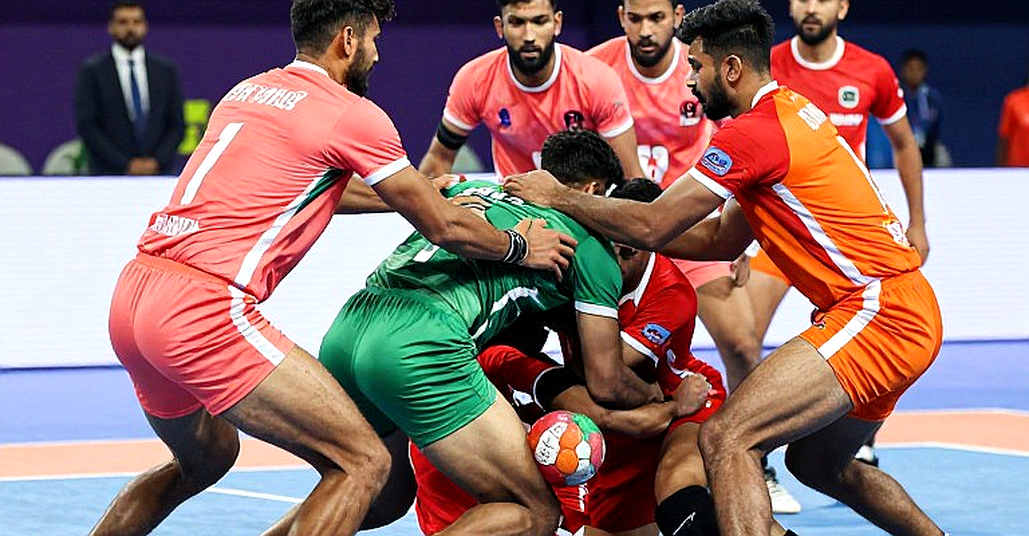
Kabaddi is a contact sport played seven against seven. The attacker, called the raider, crosses into the opponent's half, must touch a defender and return to his own half within 30 seconds to score. Throughout the raid he must continuously chant 'kabaddi-kabaddi' to prove he is not inhaling; if the chant breaks, the raid is void. The defending side scores by stopping the raider in their own half. When an entire team is ruled out, the opponent earns two bonus points and the eliminated team's players all revive, which is called an all out. This rule is the engine behind kabaddi's fast scoring and frequent comebacks. After two consecutive empty raids, the third becomes a do-or-die raid, and a tackle completed when the defending side has three or fewer players is a two-point super tackle.
India have won all three matches, beating England 46-26, Uganda 44-30 and Malaysia 37-23, scoring 127 and conceding 79. Captain Surjeet Singh is the only named player; the rest of the lineup and individual statistics are unavailable. Nigeria have fared terribly, losing 17-66 to Tanzania and 18-68 to England, margins of 49 to 50 points. The main reason is the all-out rule: once a team is under pressure, the opponent repeatedly forces all outs and the gap compounds rapidly. This is not merely a talent gap but a rule-amplified one.
India's performance deserves scrutiny. Coverage called India's start explosive and the team clear favourites, yet also conceded that India are not winning by big margins and that fans are disappointed. The data supports the skepticism: margins of 20, 14 and 14 points are comfortable but not dominant. One fact, however, shows India's defensive strength. England scored 68 against Nigeria but only 26 against India, meaning India's defense suppressed England's attack by 42 points. This is the strongest evidence of India's defensive quality. That said, conceding 23 to 30 points per game is a warning; a truly dominant defense concedes less against weak opposition. Overall, India's defense is good enough to win comfortably, not airtight.
The biggest structural fact is Iran's absence. Iran is the one nation that has genuinely beaten India at the top level, such as the 2026 Asian Games men's gold. Iran is not a Commonwealth member and is therefore excluded. Without Iran, India's three wins are against tier-two and tier-three teams and overstate India's dominance. Three tiers are clear: India at tier one, England, Tanzania, Malaysia and Uganda at tier two, and Nigeria at tier three. The 49-to-50-point margins against Nigeria define the tier-three floor.
From a regional and cultural perspective, the event shows the difference between breadth and depth in kabaddi's internationalization: many flags, few competitive nations. In India, kabaddi has moved from rural akhada traditions to a major televised product through the Pro Kabaddi League; it is India's most popular sports property after cricket and a pathway to jobs in railways, police and the army. In England, kabaddi runs mainly on the South Asian diaspora. Nigeria, Tanzania and Uganda are in early development. Tanzania and Uganda lost by around 50 points to tier-two teams, showing the gap between development and depth. The absence of Commonwealth countries with deep kabaddi traditions, such as Pakistan and Bangladesh, further thins the field. 'Commonwealth' branding gives geographic reach but not top-tier competition, because strong kabaddi nations like Iran and South Korea are not Commonwealth members. Kabaddi is not part of the Commonwealth Games, so this championship does not plug into that prestige ladder.
Commercially and in media terms, the event carries far less weight than the Pro Kabaddi League. Coverage is mainly live-streaming and telecast guides, meaning streaming-led, low-tier distribution. No data on sponsorship, rights value, player salaries or auctions is available. This is an international national-team event, not a Pro Kabaddi franchise auction, so auction-based analysis does not apply. Domestic heat exists within India's kabaddi fanbase, but this is a minor event compared with Pro Kabaddi. International influence is minimal, with audiences largely the South Asian diaspora and participating nations' local viewers.
On governance and institutions, opacity is the main risk. The source does not identify the organizer or whether the event carries International Kabaddi Federation recognition. Kabaddi has a history of parallel federations and disputed events, so the question matters. 'Commonwealth' branding without Commonwealth Games status creates a prestige-inflation risk for readers. The event does not advance kabaddi's Olympic case, because Olympic criteria require a broad field of participating countries, continental coverage and depth in the women's game, which this thin field does not provide.
Against Nigeria, India are overwhelming favourites. The analytical value lies in how big India win, as a proxy for offensive sharpness. A margin near 50 points would signal a sharp attack; a margin around 20 would signal a balanced rhythm. A further question is whether India's offense depends on a single raider. Without per-player raid points, that cannot be answered. This is a data gap, not an all-clear.
The real test in later knockout matches will be against England, the only side to post a big score here. But without Iran, India's wins should not be read as global dominance. The correct assessment is that this event is a development and promotion platform, not a benchmark of top-tier competition. India's wins are real, but their weight is set by opponent quality, and here that quality is limited.
संबंधित खिलाड़ी
लोकप्रिय/पसंदीदा पुस्तकें
The 'Commonwealth' Kabaddi Spectacle in Ahmedabad: Iran Absent, Yet the Olympic Story Rolls On2026-10-22
Captain First, Squad Later: Surjeet Singh's Leadership and the Incomplete Commonwealth Kabaddi Championship 2026 Announcement2026-10-22
Commonwealth Kabaddi Championship 2026: Surjeet Singh Captain, Naveen Kumar Deputy — and Three Questions the Press Release Leaves Blank2026-10-22
62 Matches, 13 Nations and One Missing Name: Auditing the First Commonwealth Kabaddi Championship in Ahmedabad2026-10-22
Surjeet Singh Captain, Naveen Vice-Captain: Three Unresolved Questions in the Commonwealth Kabaddi Championship Announcement2026-10-22
Commonwealth Kabaddi Championship 2026: Surjeet Singh Captain, Naveen Kumar Vice-Captain — But the Real Question Is the Metric2026-10-22
अनुशंसित
Commonwealth Kabaddi Championship 2026: Surjeet Singh Named Captain, Naveen Kumar Vice-Captain — But the Real Question Is Elsewhere2026-10-22
Commonwealth Kabaddi Championship 2026: Surjeet Singh Captain, Naveen Kumar Vice-Captain — But the Real Question Is the Rulebook, Not the Armband2026-10-22
Commonwealth Kabaddi Championship 2026: Making Surjeet Singh Captain Is Correct, But the 'Back-to-Back' Claim Is Hollow2026-10-22
From 14 to 13: Pakistan's Last-Minute Pullout in Ahmedabad and the Emptying Field of Kabaddi2026-10-22
The Ahmedabad Draw Board: Pakistan's Name Struck Out, and the Ledger of an Inaugural Championship2026-10-22
Commonwealth Kabaddi Championship 2026: India Keep Rhythm, Nigeria Blowout Expected Next2026-10-26
अनुशंसित
The 'Commonwealth' Kabaddi Spectacle in Ahmedabad: Iran Absent, Yet the Olympic Story Rolls On2026-10-22
62 Matches, 13 Nations and One Missing Name in Ahmedabad: What the Commonwealth Kabaddi Championship Is Actually For2026-10-22
Commonwealth Kabaddi Championship 2026: India Keep Rhythm, Nigeria Blowout Expected Next2026-10-26
Commonwealth Kabaddi Championship 2026: Making Surjeet Singh Captain Is Correct, But the 'Back-to-Back' Claim Is Hollow2026-10-22
The Ahmedabad Draw Board: Pakistan's Name Struck Out, and the Ledger of an Inaugural Championship2026-10-22
Commonwealth Kabaddi Championship 2026: Surjeet Singh Captain, Naveen Kumar Vice-Captain — But the Real Question Is the Metric2026-10-22
अनुशंसित
Commonwealth Kabaddi Championship: 23 Teams, 62 Matches, and the Nine Days in Ahmedabad That Will Not Prove What Everyone Wants It To2026-10-26
Commonwealth Kabaddi Championship 2026: India Keep Rhythm, Nigeria Blowout Expected Next2026-10-26
Commonwealth Kabaddi Championship 2026: Surjeet Singh Named Captain, Naveen Kumar Vice-Captain — But the Real Question Is Elsewhere2026-10-22
62 Matches, 13 Nations and One Missing Name in Ahmedabad: What the Commonwealth Kabaddi Championship Is Actually For2026-10-22
The 'Commonwealth' Kabaddi Spectacle in Ahmedabad: Iran Absent, Yet the Olympic Story Rolls On2026-10-22
Commonwealth Kabaddi Championship 2026: Surjeet Singh Captain, Naveen Kumar Deputy — and Three Questions the Press Release Leaves Blank2026-10-22